Product Life Cycle: A Strategic Guide to Managing a Product from Launch to Legacy
Introduction: Why Understanding the Product Life Cycle Is a Competitive Advantage
Every product in the market — whether it is a smartphone, a fashion trend, or a streaming service — follows a journey. It is introduced, it grows, it reaches a peak, and eventually, it declines. This journey is known as the Product Life Cycle (PLC).
For businesses, understanding the Product Life Cycle is not just academic knowledge; it is a strategic necessity. It helps in:
-
Forecasting sales and profits
-
Designing marketing strategies
-
Allocating budgets effectively
-
Planning product improvements or replacements
-
Making informed investment decisions
A company that understands where its product stands in the life cycle can make smarter decisions about pricing, promotion, distribution, and innovation. In this blog, we will explore each stage of the Product Life Cycle in depth, define every key term clearly, and illustrate each concept with real-world examples.
What is the Product Life Cycle?
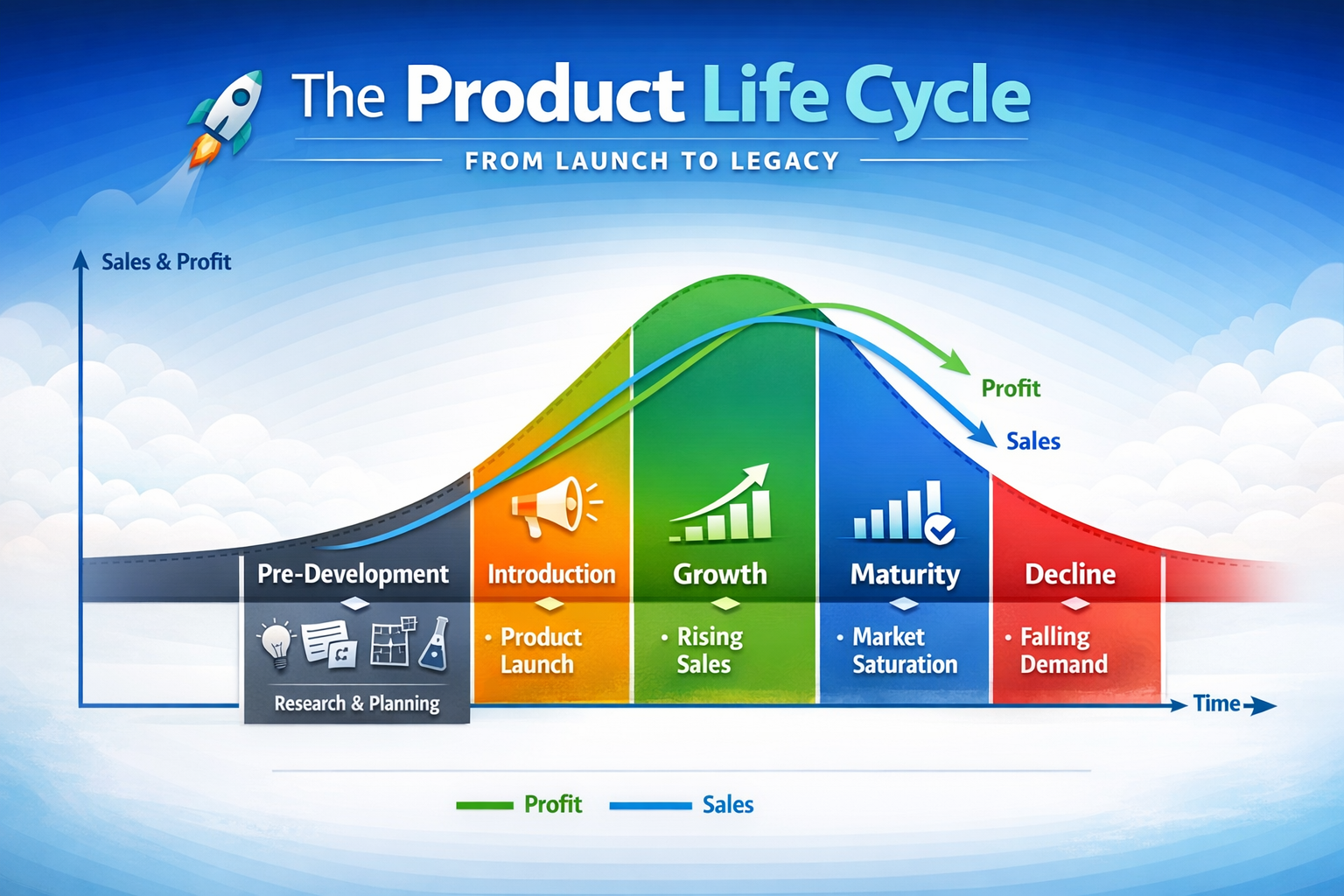
The Product Life Cycle (PLC) is a strategic business model that describes the journey of a product from its initial idea to its eventual withdrawal from the market. It explains how a product’s sales, profits, competition, and customer demand change over time.
Just like living organisms, products are born, grow, mature, and eventually decline. Understanding this cycle helps businesses plan marketing strategies, pricing decisions, production levels, and innovation timing.
The Product Life Cycle typically consists of five stages:
-
Pre-Development
-
Introduction
-
Growth
-
Maturity
-
Decline
Each stage has distinct characteristics and strategic implications.
Pre-Development Stage (Product Development Stage)
The Pre-Development Stage is the phase where the product is conceptualized, designed, tested, and prepared for market launch — but not yet available to customers.
This stage begins long before customers see the product. It includes research, planning, designing, prototyping, and testing.
At this stage:
-
There are no sales
-
There is no revenue
-
Only investment and cost
Yet, strategically, this is the most critical stage because poor decisions here can lead to failure in later stages.
Key Activities in the Pre-Development Stage
1. Idea Generation
Idea Generation is the process of creating new product concepts based on market needs, technological innovation, or business strategy.
Sources of ideas:
-
Customer feedback
-
Competitor analysis
-
Internal R&D teams
-
Market trends
2. Market Research
Market Research is the systematic collection and analysis of data about customers, competitors, and industry trends.
It helps answer:
-
Who is the target customer?
-
What problem does the product solve?
-
How large is the potential market?
3. Product Design
Product Design refers to developing the physical or digital features of the product — including functionality, aesthetics, packaging, and user experience.
4. Prototype Development
A Prototype is an early sample or model of the product used for testing and feedback before mass production.
Testing a prototype helps identify:
-
Technical issues
-
Design flaws
-
User experience problems
5. Business Analysis
Business Analysis evaluates whether the product is financially viable.
It includes:
-
Cost estimation
-
Pricing strategy planning
-
Profit forecasting
-
Break-even analysis
Financial Characteristics of This Stage
-
High Research & Development (R&D) costs
-
No revenue
-
High risk
-
Investment-heavy
R&D (Research and Development) refers to activities companies undertake to innovate and introduce new products.
Example: Pre-Development of the iPhone
Before the iPhone was launched, Apple Inc. spent years in secret development. Engineers worked on:
-
Touchscreen technology
-
User interface design
-
Software integration
-
Prototype testing
Billions were invested before a single unit was sold. That entire period was the Pre-Development Stage.
1. Introduction Stage
The Introduction Stage is the phase when a product is launched into the market for the first time. Customers are not yet aware of the product, and the company must invest heavily in promotion and distribution.
Key Characteristics
-
Low Sales Volume: Sales start slowly because awareness is limited.
-
High Costs: Marketing, advertising, and distribution expenses are high.
-
Low or Negative Profits: Companies often operate at a loss during this stage.
-
Limited Competition: Few or no competitors exist initially.
Important Terms Explained
-
Sales Volume: The total number of units sold in a given period.
-
Promotion: Activities used to inform and persuade customers (advertising, social media, PR, etc.).
-
Distribution: The process of making the product available to customers.
-
Early Adopters: Customers who are willing to try new products before the majority.
Marketing Strategy in Introduction Stage
Companies often use one of two strategies:
-
Skimming Pricing Strategy
Setting a high initial price to recover research and development costs. -
Penetration Pricing Strategy
Setting a low initial price to quickly attract customers and gain market share.
Example
When the first iPhone was launched by Apple Inc. in 2007, it was in the Introduction Stage. Sales were limited initially, awareness was building, and Apple invested heavily in marketing and distribution. The product was premium-priced (skimming strategy), targeting early adopters.
2. Growth Stage
The Growth Stage occurs when the product gains acceptance in the market. Sales begin to increase rapidly, and profits start improving.
Key Characteristics
-
Rapid Increase in Sales
-
Rising Profits
-
Increasing Competition
-
Expansion of Distribution Channels
Important Terms Explained
-
Market Acceptance: When customers begin to trust and regularly purchase the product.
-
Market Share: The percentage of total industry sales that a company controls.
-
Competitive Advantage: A unique benefit that makes a product better than competitors.
Marketing Strategy in Growth Stage
-
Improve product features.
-
Expand distribution.
-
Increase advertising.
-
Reduce prices slightly to attract more customers.
-
Build brand loyalty.
Example
After its initial success, the iPhone entered the Growth Stage. Sales increased rapidly, competitors like Samsung Electronics entered the smartphone market aggressively, and Apple expanded globally. Profits surged during this phase.
3. Maturity Stage
The Maturity Stage is when sales growth slows down because most potential customers already own the product. The market becomes saturated.
Key Characteristics
-
Peak Sales
-
Stable or Declining Profits
-
Intense Competition
-
Price Wars
Important Terms Explained
-
Market Saturation: When almost all potential customers have purchased the product.
-
Product Differentiation: Making a product appear different from competitors.
-
Brand Loyalty: When customers repeatedly buy the same brand.
Marketing Strategy in Maturity Stage
-
Introduce product variations (colors, features, packaging).
-
Offer discounts and promotions.
-
Improve customer service.
-
Focus on retaining existing customers.
Example
Soft drinks like Coca-Cola are in the Maturity Stage in many markets. The Coca-Cola Company maintains sales through branding, advertising campaigns, and product variations such as Diet Coke and Coca-Cola Zero.
4. Decline Stage
The Decline Stage occurs when sales begin to fall consistently due to changing consumer preferences, technological advancements, or increased competition.
Key Characteristics
-
Falling Sales
-
Reduced Profits
-
Shrinking Market
-
Product Withdrawal
Important Terms Explained
-
Obsolescence: When a product becomes outdated due to newer alternatives.
-
Discontinuation: When a company stops producing a product.
-
Cost Cutting: Reducing expenses to maintain profitability.
Marketing Strategy in Decline Stage
-
Reduce marketing expenses.
-
Focus on niche markets.
-
Discontinue the product.
-
Reposition or rebrand the product.
Example
DVD players declined significantly after the rise of streaming platforms like Netflix. As online streaming became dominant, physical media devices entered the Decline Stage.
Case Study : DVD Players — Technological Disruption and Accelerated Decline

The DVD player industry offers a contrasting example — one that highlights how technological disruption can compress and accelerate the Product Life Cycle.
Introduction Stage: Replacing VHS Technology
DVD players entered the market in the late 1990s as a superior alternative to VHS tapes.
Advantages included:
-
Better video quality
-
Compact discs
-
Easy navigation
-
Durability
Initially, prices were high, and adoption was limited to early adopters. Over time, awareness increased, and prices gradually reduced.
Growth Stage: Mass Adoption and Global Expansion
During the early 2000s, DVD players entered a strong Growth Stage.
Key characteristics:
-
Rapid increase in household adoption
-
Falling prices
-
Increasing competition among manufacturers
Retailers and rental stores expanded DVD inventory, and movie production companies shifted distribution formats.
This period represented peak optimism for the industry.
Maturity Stage: Saturation and Price Competition
By the mid-2000s, most households owned DVD players.
This led to:
-
Market saturation
-
Intense price competition
-
Reduced profit margins
Companies attempted differentiation through:
-
Slim designs
-
Home theater integration
-
Recording features
However, innovation was incremental rather than transformational.
Decline Stage: Streaming Revolution
The true disruption came with the rise of streaming platforms such as Netflix.
Streaming offered:
-
Instant access
-
No physical storage
-
Subscription-based pricing
-
On-demand convenience
Consumer behavior shifted dramatically. Physical media demand dropped sharply.
Unlike the iPhone case, DVD manufacturers did not successfully reinvent the product category. As a result:
-
Sales declined rapidly.
-
Production decreased.
-
Retail shelf space reduced.
The decline was accelerated by digital transformation.