
The Ultimate Guide to Using Google Trends for Strategic Growth
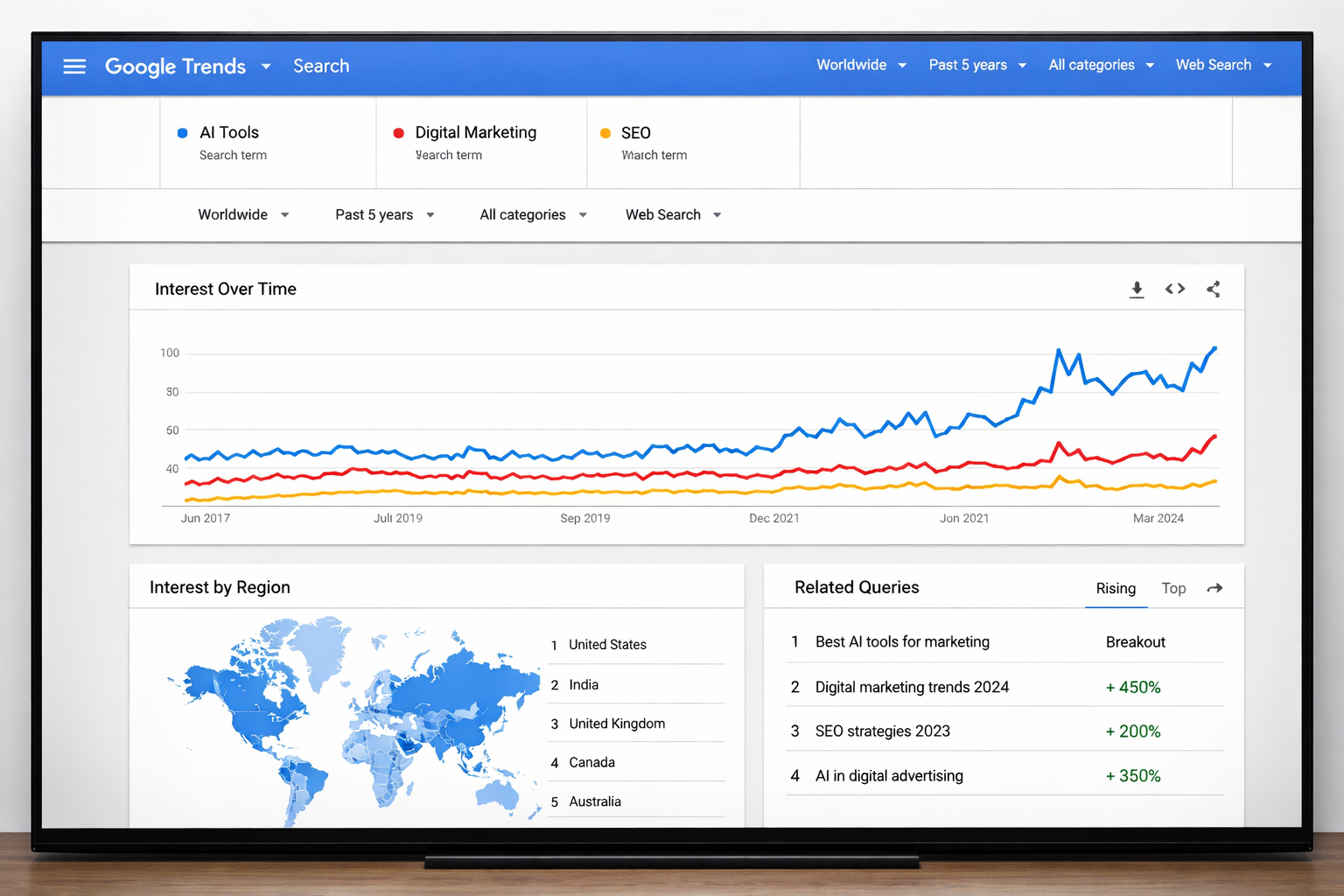
Google Trends is a free analytics tool developed by Google that analyzes a portion of global search data to show how interest in a specific topic changes over time.
Unlike traditional keyword tools, it does not provide exact search volume numbers. Instead, it provides relative search interest indexed from 0 to 100.
-
100 represents peak popularity
-
50 represents half of peak popularity
-
0 indicates insufficient data
The real power lies not in the number — but in the pattern.
Google Trends helps answer critical questions:
-
Is interest rising or declining?
-
Is the topic seasonal?
-
Which regions show strongest demand?
-
Are related searches emerging rapidly?
-
How does one keyword compare to another?
This makes it a demand-direction tool rather than a volume-estimation tool.
Why Google Trends Is a Competitive Advantage
Most marketers make decisions based on keyword volume alone.They look at numbers like 10,000 searches per month and assume it’s a good opportunity. But search volume only tells you how popular something is right now. It does not tell you where demand is heading. And in marketing, direction matters more than position ,Volume is static and Trend direction is dynamic.
A keyword with high volume but declining interest is a shrinking market. Even if it looks attractive today, you may be entering at the peak — just before demand drops. That means higher competition, increasing acquisition costs, and lower long-term ROI.
On the other hand, a keyword with moderate or even low volume that shows consistent upward growth represents expanding demand. It signals increasing awareness, rising curiosity, and growing market adoption. Entering at this stage allows you to build authority before the space becomes crowded.
This is where Google Trends becomes a strategic tool rather than just a research platform.
It helps you answer critical forward-looking questions:
-
Is this topic gaining momentum or losing relevance?
-
Is this spike temporary or part of a long-term growth pattern?
-
Is consumer interest accelerating?
-
Are new related queries emerging around this topic?
These insights allow you to anticipate demand shifts instead of reacting to them.
Timing as a Growth Multiplier
In marketing, timing multiplies results.Publishing content when interest is already peaking means competing with established players. Publishing content when interest is steadily rising means capturing authority early.
Early positioning leads to:
-
Easier SEO rankings
-
Lower paid advertising costs
-
Stronger brand association with the topic
-
Higher long-term organic traffic
When you consistently align your strategy with growing demand curves, you compound results over time.
From Reactive Marketing to Predictive Marketing
Most businesses operate reactively:
-
They see competitors publishing content.
-
They notice a trend becoming popular.
-
Then they enter the market late.
By that time, competition is high and differentiation is harder.
Google Trends enables predictive marketing:
-
Detect early growth signals.
-
Validate consistency in upward movement.
-
Build content and campaigns before saturation.
-
Establish topical authority early.
This shift from reactive execution to predictive positioning creates a sustainable competitive advantage.
Strategic Example
Imagine two marketers analyzing the same niche:
-
Marketer A chooses a keyword with 20,000 monthly searches but declining trend.
-
Marketer B chooses a keyword with 5,000 monthly searches but strong upward momentum.
Six months later:
-
The declining keyword becomes harder to monetize.
-
The rising keyword doubles in search interest.
-
Marketer B now ranks as an early authority in a growing category.
The difference was not budget.It was timing informed by trend direction.
The Real Advantage
- Google Trends does not just show popularity.
- It shows momentum.
- Momentum indicates where attention is flowing next. And in the digital economy, attention determines opportunity.
- When you consistently align your content, ads, and product positioning with rising search behavior, you stop competing for existing demand and start capturing future demand.
That is the true competitive advantage.
The 5-Step Trend-Based Marketing Framework
Step 1: Analyze Long-Term Demand Momentum
Before evaluating opportunity, zoom out , Set the time filter to 5 years and study the overall trajectory. You’re looking for patterns, not spikes.
There are four possible demand behaviors:
-
Consistent Upward Growth – Indicates expanding market adoption.
-
Stable Demand – Reliable evergreen niche.
-
Seasonal Cycles – Predictable demand fluctuations.
-
Gradual Decline – Shrinking relevance.
- If a topic shows steady upward growth, it signals long-term scalability.
- If it shows repeated seasonal spikes, it’s ideal for calendar-based campaigns.
- If it shows decline, entering that market may require higher differentiation.
Strategic insight begins with macro pattern recognition.
Step 2: Compare Keyword Variations to Detect Attention Shifts
Markets evolve. Terminology changes. Consumer language adapts.For example:
-
“Online marketing course”
-
“Digital marketing course”
-
“Performance marketing course”
Search behavior reveals more than demand — it shows language preference, and language preference shapes SEO opportunity. When one keyword variation accelerates while another plateaus, it signals a shift in future dominance. Instead of competing in crowded, mature categories, aligning with emerging terminology allows you to capture growing demand early. This strategic move helps you build topical authority before the space becomes saturated.
Step 3: Identify Geographic Demand Clusters
Not all markets grow uniformly.
Google Trends allows you to see where interest is strongest.
This insight enables strategic localization:
-
Create region-specific landing pages
-
Launch geo-targeted ad campaigns
-
Adjust messaging to regional demand
-
Prioritize high-growth areas
For example, if interest in a topic is accelerating in Tier-1 cities but stagnant elsewhere, your paid campaigns and content positioning should reflect that.
Geographic demand intelligence increases conversion efficiency and reduces wasted spend.
Step 4: Extract Emerging Subtopics from Related Queries
This is where you can:
-
Publish supporting content
-
Expand topic clusters
-
Build topical authority
-
Dominate micro-niches early
For instance, if “AI marketing tools” begins trending and related queries show “AI content generator for SEO” rising rapidly, that subtopic may represent the next opportunity layer.
Strategic marketers build content ecosystems, not isolated articles.
Step 5: Validate Opportunity Size Before Scaling
Trend direction alone is not enough.
Once upward momentum is confirmed, validate using SEO tools:
-
Monthly search volume
-
Keyword difficulty
-
Competitive density
-
CPC (commercial intent indicator)
This ensures that:
-
The opportunity is scalable
-
The niche has monetization potential
-
Competition is manageable
- Google Trends shows momentum.
- SEO validation confirms economic viability.
Together, they create predictive strategy.
From Insight to Execution
The difference between average and elite marketers is execution discipline.
Google Trends becomes powerful when integrated into a routine:
Weekly:
-
Analyze 3–5 core keywords
-
Track directional changes
-
Review breakout queries
Monthly:
-
Identify seasonal cycles
-
Adjust content calendar
-
Realign paid campaign timing
Consistency builds predictive advantage.
The Strategic Outcome
When you apply this framework:
-
You stop creating content based on assumptions.
-
You stop entering markets at saturation.
-
You start aligning with demand before competitors react.
This is how trend analysis evolves into market positioning.
And in digital marketing, positioning determines profitability.
Seasonal Marketing Intelligence
Many industries do not grow randomly. They grow in cycles.
Consumer behavior follows predictable seasonal patterns driven by:
-
Cultural events
-
Festivals and holidays
-
Academic calendars
-
Weather changes
-
Social and psychological triggers
For example:
-
Holiday shopping searches surge before major festivals.
-
Travel-related queries increase before vacation seasons.
-
Exam preparation searches spike months before exam dates.
-
Fitness-related searches rise sharply at the beginning of the year.
These patterns repeat every year. They are not surprises — they are signals.
Google Trends allows marketers to visualize these recurring cycles clearly by analyzing multi-year search data. When you examine a keyword over a 3–5 year period, seasonal spikes often appear like repeating waves.
That repetition is strategic intelligence.
Why Seasonal Forecasting Is Important
Most businesses launch campaigns when demand is already at its peak.
At peak demand:
-
Competition is at its highest
-
Advertising costs increase
-
Organic rankings are harder to achieve
-
Audience attention is fragmented
Entering at the peak means fighting in the most crowded environment.
Advanced strategy is different.
Instead of launching during the peak, strategic marketers launch during the acceleration phase — typically 60–90 days before maximum search volume.
This period is critical because:
-
Demand is rising steadily
-
Competition is not yet saturated
-
Cost-per-click (CPC) is often lower
-
Organic content has time to rank
You are positioning yourself before the market becomes crowded.
The Strategic Impact of Early Entry
Launching 60–90 days before peak demand creates multiple advantages:
1. SEO Advantage
Search engines need time to crawl, index, and rank content.
Publishing early allows your pages to gain visibility before competition intensifies.
2. Advertising Efficiency
Running ads early allows you to test creatives, refine targeting, and gather performance data before CPCs rise.
3. Audience Warm-Up
You can build remarketing audiences, email lists, and brand familiarity before peak season.
4. Authority Positioning
When demand peaks, your brand is already visible and trusted.
Instead of competing aggressively at the peak, you dominate during it.
Example of Seasonal Intelligence in Action
Imagine a brand selling exam preparation courses.
Google Trends shows that searches for “exam preparation online” begin rising in January, peak in March, and decline after exams.
A reactive marketer launches campaigns in March.
A strategic marketer:
-
Publishes optimized content in January
-
Starts ads in February
-
Builds email leads early
By March, the strategic marketer:
-
Ranks organically
-
Has optimized campaigns
-
Has a warm audience ready to convert
Same market. Different timing. Dramatically different results.
The Bigger Strategic Insight
Seasonality teaches one fundamental principle:
Demand is predictable.
Google Trends turns that predictability into actionable intelligence.
When marketers align content, ads, and product launches with seasonal acceleration phases, they reduce costs, improve visibility, and maximize ROI.
Timing does not just influence results.
It multiplies them.
Case Study: How Early Seasonal Positioning Multiplied Results
Industry: Online Fitness Programs
A fitness coaching brand wanted to increase enrollments for its “Home Workout Program.”
Instead of guessing launch timing, the marketing team analyzed 5 years of data using Google Trends for keywords like:
-
“home workout plan”
-
“weight loss program”
-
“gym at home”
What They Discovered
The data showed a clear pattern:
-
Search interest began rising in early December
-
It accelerated rapidly in late December
-
It peaked sharply in the first two weeks of January
-
It declined gradually after February
This pattern repeated every year.
The spike was driven by New Year resolutions — a predictable psychological trigger.
Two Different Strategies
❌ Reactive Approach (Common Strategy)
Most competitors launched heavy ad campaigns in January.
At that point:
-
CPC costs were high
-
Competition was intense
-
Ad creatives looked similar
-
Organic rankings were already dominated
They were fighting at the peak.
✅ Strategic Approach (Using Seasonal Intelligence)
Instead of launching in January, the fitness brand executed this plan:
Early December
-
Published SEO-optimized blog content
-
Launched YouTube workout previews
-
Began low-budget awareness ads
Late December
-
Retargeted engaged users
-
Offered early-bird discounts
-
Collected email leads
January (Peak Demand)
-
Increased ad budget strategically
-
Promoted limited-time offers
-
Leveraged warm remarketing audiences
The Result
Compared to the previous year:
-
Cost per acquisition decreased by 28%
-
Organic traffic increased by 42%
-
Conversion rate improved due to warm audience targeting
-
January revenue doubled
The difference was not budget.
The difference was timing.
Key Strategic Lesson
Seasonal demand is not random. It is cyclical and measurable.
Google Trends allowed the brand to:
-
Forecast demand acceleration
-
Enter the market before saturation
-
Optimize campaigns before peak competition
-
Scale efficiently during maximum interest
Instead of reacting to seasonal demand, they anticipated it.
That anticipation created a measurable competitive advantage.
Case Study : Using Seasonal Intelligence in the Travel Industry
Industry: Travel & Vacation Packages
A travel agency specializing in domestic holiday packages wanted to increase bookings for summer vacations.
Instead of launching promotions randomly, the team analyzed 5 years of Google Trends data for keywords such as:
-
“summer vacation packages”
-
“family holiday destinations”
-
“best places to visit in summer”
What the Data Revealed
The trend analysis showed a consistent pattern:
-
Search interest began rising in February
-
Accelerated significantly in March
-
Peaked in April
-
Declined sharply after mid-May
This pattern repeated annually.
Most travel companies were aggressively advertising in April — during peak demand.
But peak demand also meant:
-
Higher advertising costs
-
Intense competition
-
Reduced profit margins
-
Late customer decision cycles
Strategic Seasonal Execution
Instead of waiting for April, the agency implemented a phased plan:
Phase 1: Early Awareness (February)
-
Published SEO-optimized travel blogs
-
Created “Top 10 Summer Destinations” content
-
Launched educational YouTube travel guides
-
Started low-budget brand awareness ads
Phase 2: Engagement & Lead Capture (March)
-
Offered early-bird discounts
-
Collected email signups for exclusive deals
-
Ran retargeting campaigns
-
Built remarketing audiences
Phase 3: Conversion Scaling (April – Peak)
-
Increased ad budget strategically
-
Targeted warm audiences first
-
Promoted limited-time offers
-
Highlighted social proof and reviews
The Outcome
Compared to the previous year:
-
Booking volume increased by 35%
-
Cost per booking decreased by 22%
-
Website traffic grew organically before competitors intensified spending
-
Customer acquisition started earlier in the decision cycle
The agency did not outspend competitors.
They out-timed them.
Strategic Insight
Travel decisions often begin weeks before booking.
By entering during the acceleration phase — rather than the peak — the agency:
-
Influenced early research behavior
-
Positioned itself as a trusted option
-
Reduced reliance on last-minute paid traffic
This demonstrates a fundamental principle:
Seasonal intelligence allows brands to control demand cycles instead of reacting to them
Industry: Travel & Vacation Packages
A travel agency specializing in domestic holiday packages wanted to increase bookings for summer vacations.
Instead of launching promotions randomly, the team analyzed 5 years of Google Trends data for keywords such as:
-
“summer vacation packages”
-
“family holiday destinations”
-
“best places to visit in summer”
What the Data Revealed
The trend analysis showed a consistent pattern:
-
Search interest began rising in February
-
Accelerated significantly in March
-
Peaked in April
-
Declined sharply after mid-May
This pattern repeated annually.
Most travel companies were aggressively advertising in April — during peak demand.
But peak demand also meant:
-
Higher advertising costs
-
Intense competition
-
Reduced profit margins
-
Late customer decision cycles
Strategic Seasonal Execution
Instead of waiting for April, the agency implemented a phased plan:
Phase 1: Early Awareness (February)
-
Published SEO-optimized travel blogs
-
Created “Top 10 Summer Destinations” content
-
Launched educational YouTube travel guides
-
Started low-budget brand awareness ads
Phase 2: Engagement & Lead Capture (March)
-
Offered early-bird discounts
-
Collected email signups for exclusive deals
-
Ran retargeting campaigns
-
Built remarketing audiences
Phase 3: Conversion Scaling (April – Peak)
-
Increased ad budget strategically
-
Targeted warm audiences first
-
Promoted limited-time offers
-
Highlighted social proof and reviews
The Outcome
Compared to the previous year:
-
Booking volume increased by 35%
-
Cost per booking decreased by 22%
-
Website traffic grew organically before competitors intensified spending
-
Customer acquisition started earlier in the decision cycle
The agency did not outspend competitors.
They out-timed them.
Strategic Insight
Travel decisions often begin weeks before booking.
By entering during the acceleration phase — rather than the peak — the agency:
-
Influenced early research behavior
-
Positioned itself as a trusted option
-
Reduced reliance on last-minute paid traffic
This demonstrates a fundamental principle:
Seasonal intelligence allows brands to control demand cycles instead of reacting to them