
Content Marketing
A Strategic Guide to Attracting and Retaining Customers
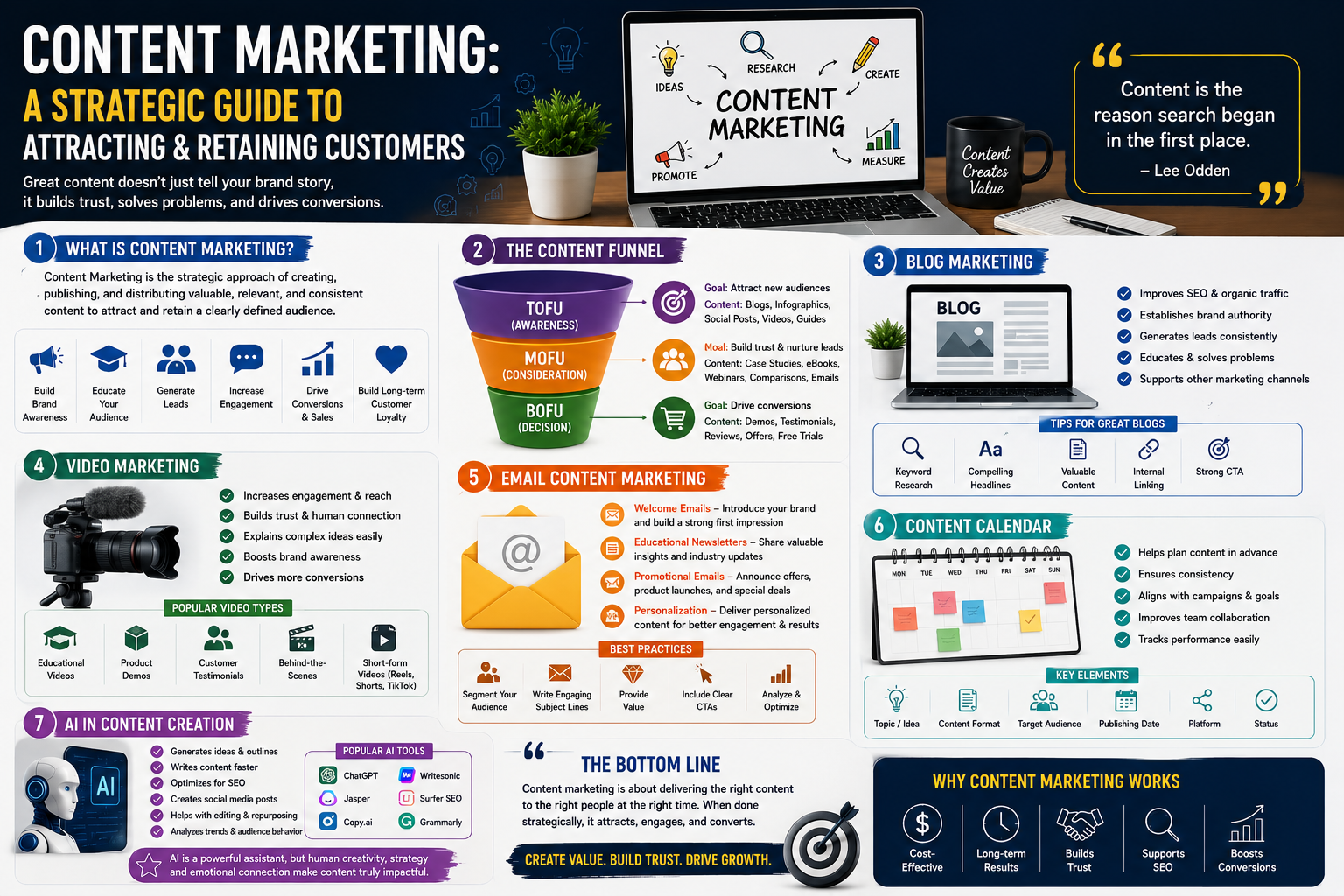
Introduction
In today’s digital world, customers no longer want to be sold to—they want to be educated, entertained, and inspired. This shift has made content marketing one of the most powerful strategies for building trust, attracting audiences, and creating long-term customer relationships.
From blogs and videos to emails and social media posts, valuable content helps brands connect with customers at every stage of the buying journey. Businesses that consistently create high-quality content not only generate more leads but also establish themselves as industry authorities.
This guide explores the fundamentals of content marketing, the content funnel, blogging, video marketing, email content strategies, content planning, and the growing impact of artificial intelligence on content creation.
What is Content Marketing?
Content Marketing is a strategic approach focused on creating, publishing, and distributing valuable, relevant, and consistent content to attract and retain a clearly defined audience.
Unlike traditional advertising, content marketing emphasizes value creation rather than direct selling.
The primary goals of content marketing include:
- Building brand awareness
- Educating potential customers
- Generating qualified leads
- Increasing customer engagement
- Improving search engine rankings
- Driving conversions and sales
- Building long-term customer loyalty
Content marketing works because it helps customers solve problems and make informed decisions.
Popular forms of content include:
- Blog articles
- Videos
- Social media posts
- Podcasts
- Infographics
- E-books
- Newsletters
- Case studies
Modern businesses increasingly rely on content marketing as the foundation of their digital marketing strategies.
Understanding the Content Funnel
Customers interact with content differently depending on their stage in the buying journey.
The Content Funnel helps marketers create appropriate content for each stage.
Top of the Funnel (TOFU): Awareness Stage
At this stage, customers are identifying problems and searching for information.
The goal is to attract new audiences and build awareness.
Examples of TOFU content include:
- Educational blog posts
- Infographics
- Social media content
- Beginner guides
- YouTube tutorials
- Industry reports
Examples:
- “What is Digital Marketing?”
- “SEO Basics for Beginners”
- “Top Social Media Trends in 2026”
The focus should be on education rather than promotion.
Middle of the Funnel (MOFU): Consideration Stage
Customers are now evaluating solutions and comparing alternatives.
The goal is to build trust and demonstrate expertise.
Examples include:
- Case studies
- Webinars
- Product comparisons
- E-books
- Email sequences
- Expert interviews
Businesses should position themselves as trusted advisors during this stage.
Bottom of the Funnel (BOFU): Decision Stage
At this stage, customers are ready to make purchasing decisions.
The objective is conversion.
Examples include:
- Product demonstrations
- Customer testimonials
- Free trials
- Pricing pages
- Success stories
- Personalized offers
Strong calls-to-action become important during this phase.
Blog Marketing
Blogging remains one of the most effective content marketing strategies.
High-quality blogs improve:
- Search engine visibility
- Brand authority
- Website traffic
- Lead generation
- Customer trus
Benefits of Blogging
Regular blogging helps businesses:
- Rank for relevant keywords
- Educate potential customers
- Generate organic traffic
- Build industry credibility
- Support social media content
Blogs provide long-term value because they continue attracting visitors long after publication.
Writing Effective Blog Content
Successful blogs typically include:
- Compelling headlines
- Clear structure
- Valuable information
- Visual elements
- Strong calls-to-action
Content should focus on solving real customer problems rather than promoting products aggressively.
SEO and Blog Marketing
Search Engine Optimization plays a critical role in blog success.
Key SEO practices include:
- Keyword research
- Internal linking
- Meta descriptions
- Image optimization
- Mobile responsiveness
Combining content marketing with SEO creates sustainable traffic growth.
Video Marketing
Video has become one of the most engaging content formats in the digital era.
Consumers increasingly prefer watching videos over reading long text content.
Why Video Marketing Matters
Videos help businesses:
- Increase engagement
- Improve brand awareness
- Explain complex concepts
- Build trust
- Increase conversions
Research consistently shows that video content generates higher engagement rates than most other formats.
Popular Types of Marketing Videos
Examples include:
Educational Videos
Teaching customers about products, industries, or solutions.
Example:
“How to Use Google Analytics 4”
Product Demonstrations
Showing how products work and highlighting benefits.
These videos help customers make purchasing decisions.
Customer Testimonials
Real customer experiences build trust and credibility.
Social proof remains one of the strongest marketing influences.
Behind-the-Scenes Content
Businesses use behind-the-scenes videos to humanize their brands and create stronger emotional connections.
Short-Form Video Content
Platforms such as:
- Instagram Reels
- YouTube Shorts
- TikTok
have transformed digital marketing.
Short-form videos provide:
- High engagement
- Better reach
- Increased discoverability
Video marketing will continue dominating content strategies in the coming years.
Email Content Marketing
Email marketing remains one of the highest-return digital marketing channels.
It allows businesses to communicate directly with customers and nurture long-term relationships.
Welcome Emails
Welcome emails introduce new subscribers to the brand.
They typically include:
- Brand story
- Important resources
- Exclusive offers
- Community information
First impressions are critical in email marketing.
Educational Newsletters
Educational emails provide valuable insights and information.
Examples include:
- Industry trends
- Marketing tips
- New blog updates
- Expert opinions
Providing value helps maintain subscriber engagement.
Promotional Emails
Promotional content focuses on:
- Product launches
- Discounts
- Seasonal campaigns
- Special offers
Effective promotional emails balance sales objectives with customer value.
Personalization in Email Marketing
Modern email marketing emphasizes personalization.
Examples include:
- Personalized recommendations
- Behavioral triggers
- Dynamic content
- Customer segmentation
Personalized emails generally achieve higher engagement and conversion rates.
Building a Content Calendar
Consistency is one of the most important factors in content marketing success.
A content calendar helps businesses plan, organize, and execute their strategies effectively.
Benefits of a Content Calendar
A well-structured content calendar helps:
- Maintain publishing consistency
- Align marketing campaigns
- Reduce last-minute planning
- Improve team collaboration
- Track performance
Planning ahead leads to better content quality and efficiency.
Components of a Content Calendar
A typical content calendar includes:
- Content topic
- Target audience
- Publishing date
- Platform
- Content format
- Keywords
- Status tracking
Businesses often use tools such as:
- Trello
- Notion
- Google Sheets
- Asana
- HubSpot
for content management.
Content Frequency
Publishing schedules depend on business goals and available resources.
Examples include:
- Blog posts: 1–2 times per week
- Instagram: Daily or 4–5 times per week
- LinkedIn: 3–4 times per week
- YouTube: Weekly uploads
- Email newsletters: Weekly or bi-weekly
Consistency matters more than volume.
AI in Content Creation
Artificial Intelligence is rapidly changing the content marketing landscape.
AI tools help marketers improve productivity, efficiency, and creativity.
AI Content Writing Tools
Popular AI tools include:
- ChatGPT
- Jasper
- Copy.ai
- Gemini
- Claude
These platforms assist with:
- Blog ideas
- Content outlines
- Draft generation
- SEO optimization
- Social media captions
AI for Content Research
AI helps marketers:
- Identify trends
- Analyze competitors
- Generate keywords
- Understand customer interests
This reduces research time and improves strategic decision-making.
AI in Video Content
AI-powered tools now support:
- Video editing
- Automatic subtitles
- Voice generation
- Thumbnail creation
- Script writing
Video production has become faster and more accessible.
The Human Element
Although AI provides efficiency, human creativity remains essential.
Successful content marketing still requires:
- Authentic storytelling
- Personal experiences
- Emotional intelligence
- Strategic thinking
The future belongs to marketers who combine AI capabilities with human creativity and expertise.